A technician reaches into a jammed conveyor belt. The machine seems dead—no lights, no hum. But someone on the other side hits the restart button. In seconds, a life is changed. This isn’t a worst-case scenario—it happens more than it should. The solution? Lock out tag out locks. They’re not just hardware; they’re a system, a procedure, and a culture designed to prevent accidental energization of machinery during maintenance.
Lock out tag out (LOTO) locks are physical devices that secure energy-isolating mechanisms—like circuit breakers, valves, or disconnect switches—so equipment can’t be operated until maintenance or servicing is complete. Paired with tags that communicate why the lock is in place and who installed it, these locks form the backbone of one of the most effective industrial safety protocols in existence.
Why Lock Out Tag Out Locks Are Non-Negotiable
The stakes are high. According to OSHA, failure to control hazardous energy accounts for nearly 10% of serious accidents in industries like manufacturing, construction, and utilities. These incidents range from amputations and burns to fatalities. The root cause is often bypassed or improperly applied lockout procedures.
LOTO locks eliminate ambiguity. When a lock is in place, it’s not a suggestion—it’s a physical barrier. No one can restart a machine without removing the lock, and only the person who applied it should have the key. This creates accountability and prevents well-meaning but dangerous actions like “quick fixes” or miscommunication during shift changes.
For example, consider a maintenance team servicing a hydraulic press. Without LOTO locks, a second shift worker unaware of the maintenance might power up the system, triggering catastrophic motion. With a lock in place on the main disconnect, that risk drops to near zero.
How Lock Out Tag Out Systems Work in Practice
A proper LOTO system involves five core steps, with locks playing a central role:
- Prepare for shutdown – Identify all energy sources (electrical, pneumatic, hydraulic, thermal, chemical).
- Shut down the equipment – Use standard procedures to power down.
- Isolate energy sources – Engage disconnects, close valves, block moving parts.
- Apply lock out tag out locks and tags – Each worker places their personal lock and tag on each isolation point.
- Verify de-energization – Test the machine to ensure it cannot start.
The lock is applied after isolation but before any work begins. Each worker involved in the maintenance task applies their own lock. This “one person, one lock, one key” principle ensures no single individual can restart equipment without explicit knowledge and consent from everyone involved.
A common mistake? Group lockout boxes used incorrectly. While a group lockout station can hold multiple locks, each worker must still apply their personal lock to the energy source. Relying solely on a master lock held by a supervisor defeats the purpose.
Types of Lock Out Tag Out Locks and Where They’re Used
Not all locks are the same. Choosing the right LOTO lock depends on the environment, energy type, and isolation mechanism.
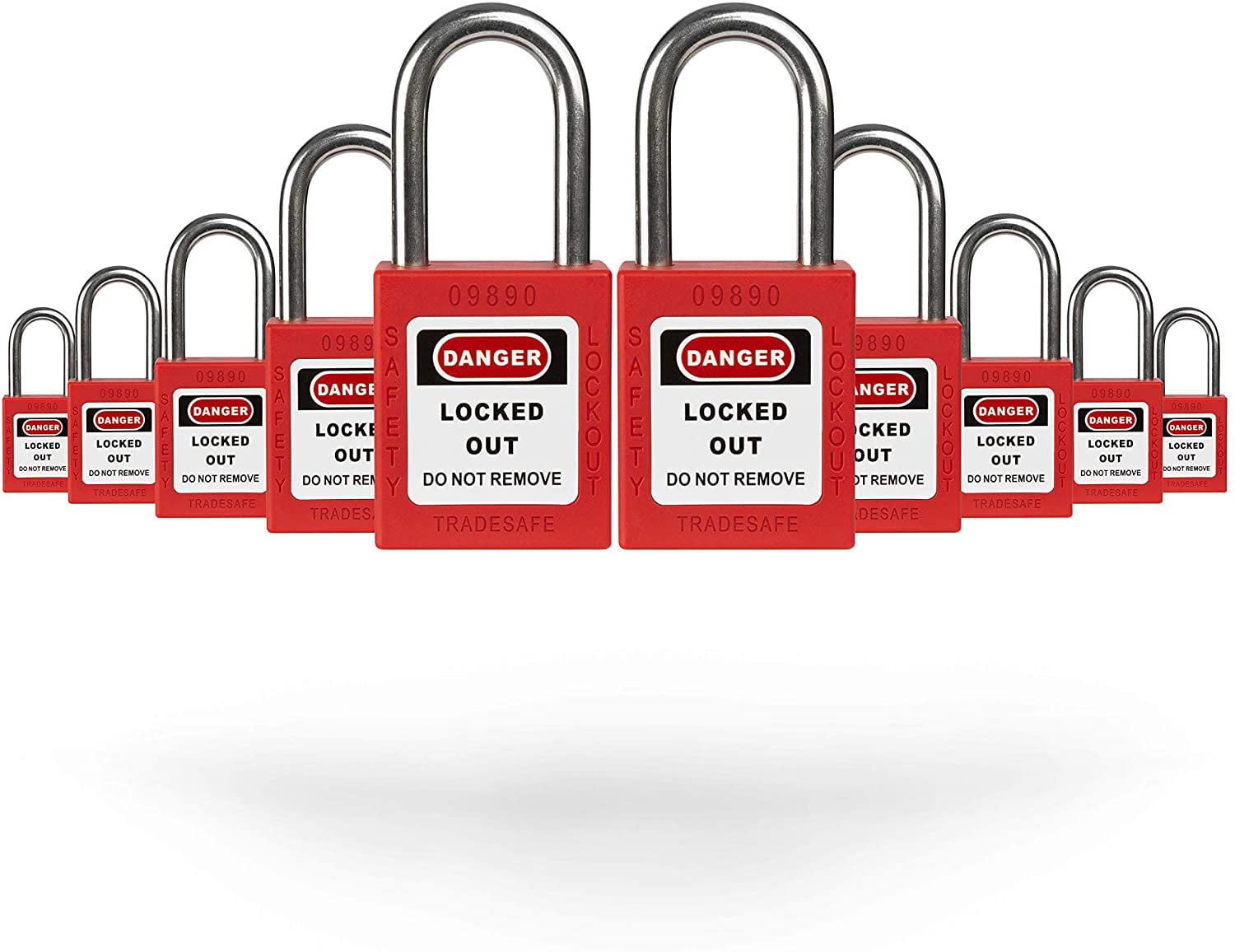
Padlock-Style Locks The most common type, these resemble standard padlocks but are built for safety compliance. They’re typically made from non-conductive materials like nylon or polycarbonate to prevent electrical conductivity. Available in multiple colors, they help differentiate departments or energy types.
Use Case: Electrical panels in manufacturing plants.
Valve Lockouts Designed to secure ball valves, gate valves, or pneumatic controls. These aren’t standalone locks but enclosures that prevent valve operation. The actual LOTO lock secures the device in place.
Use Case: Chemical processing units where fluid flow must be isolated.
Circuit Breaker Locks
These slide over breaker toggles, preventing them from being flipped. They come in universal and model-specific designs to fit various breaker sizes.
Use Case: HVAC systems or industrial control panels.
Plug Lockouts Prevent electrical plugs from being inserted into outlets. Used when equipment must be fully disconnected.
Use Case: Portable machinery like grinders or saws.
Hasp Locks Used when multiple workers need to lock out a single point. A hasp allows several locks to be attached to one isolation device.
Use Case: Large compressors with a single main disconnect.
Common Mistakes That Undermine LOTO Effectiveness
Even with the right locks, flawed execution renders the system useless. Here are real-world pitfalls:
- Using personal locks for non-LOTO purposes – A worker using their red safety lock as a locker lock risks losing it or normalizing its presence.
- Tagging without locking – Tags alone are not sufficient. They can be ignored or removed. Locks enforce compliance.
- Sharing keys – If multiple people have keys to a lock, control is lost. Each lock should have one key, held only by the authorized employee.
- Failing to train temporary or contract workers – Outsourced staff must be trained and equipped with their own locks.
- Skipping group lockout procedures – In team maintenance, not every worker applying a lock is a critical failure point.
One plant reduced its near-miss incidents by 73% simply by auditing LOTO compliance weekly and replacing shared locks with individual ones.
Industry-Specific Applications of LOTO Locks
Manufacturing Assembly lines use robotic arms, presses, and conveyors—all high-risk during maintenance. LOTO locks are applied at motor disconnects, control cabinets, and air supply valves. Color-coding locks by department (e.g., red for electrical, blue for mechanical) improves clarity.
Oil & Gas Valves controlling flammable substances require robust isolation. Double block and bleed systems often use multiple valve lockouts. Because environments are often corrosive, stainless steel or UV-resistant plastic locks are standard.
Healthcare Hospitals use LOTO for MRI machines, sterilizers, and HVAC systems. Despite being less industrial, the risks are just as real. An MRI machine’s magnetic field can become active unexpectedly if not properly de-energized.
Utilities Power substations and water treatment plants rely on LOTO during servicing. Here, padlocks with extended shackle lengths accommodate large switches and breakers.
Top 5 Lock Out Tag Out Locks on the Market
Choosing reliable hardware matters. These five options are widely trusted across industries:

| Product | Key Features | Best For |
|---|---|---|
| Master Lock 4683DAT | Durable nylon body, 38mm wide, non-conductive shackle | Electrical panels, general use |
| Grace Industries G1200 | Heavy-duty polymer, UV-resistant, key-retaining design | Outdoor or harsh environments |
| Seton 65606-7 | Bright red color, 12-pack with individual keys | Group lockout programs |
| RS Pro 155-688 | Compact design, ideal for tight spaces | Control cabinets, small breakers |
| SafelyNow Smart LOTO Lock | Bluetooth-enabled, integrates with digital LOTO apps | Companies digitizing safety workflows |
When selecting, prioritize durability, visibility, and compatibility with your isolation devices. A lock that doesn’t fit the breaker is as useless as no lock at all.
Integrating LOTO Locks Into a Broader Safety Culture
Hardware is only one piece. A successful LOTO program requires training, auditing, and leadership buy-in.
Start with documented procedures for every machine. These should list all energy sources and the exact steps to isolate them. Train employees not just on how to use locks, but why—connecting the practice to real-life consequences increases compliance.
Conduct regular audits. Walk through maintenance tasks and observe whether workers follow each step. Surprise audits are more effective than scheduled ones.
Finally, encourage reporting. If a worker finds a missing lock or a bypassed procedure, that’s valuable data—not a failure. Reward vigilance, not speed.
One plant introduced a “LOTO Champion” program, where experienced technicians mentor others. Within six months, compliance rose from 64% to 98%.
The Bottom Line: Safety Isn’t Optional
Lock out tag out locks are more than a regulatory checkbox. They’re a daily commitment to protecting human lives. In an era of automation and efficiency pressures, it’s easy to cut corners—until an accident happens.
The right lock, applied correctly, by the right person, at the right time, can prevent a lifetime of regret. Invest in quality hardware. Train relentlessly. Audit consistently. And never assume someone else has secured the machine.
Protect your team. Lock it out. Tag it. Verify it. Every time.
FAQ
What is the difference between lock out and tag out? Lock out uses a physical lock to prevent equipment activation, while tag out uses a label to warn others not to operate it. OSHA requires lock out where feasible; tag out alone is only allowed in specific cases.
Can one lock be used for multiple energy sources? No. Each energy source must be isolated and locked separately. One machine might require several locks on different disconnects.
Who should apply LOTO locks? Only authorized employees trained in energy control procedures should apply locks. Each worker performing maintenance must apply their own lock.
What materials are LOTO locks made from? Most are made from non-conductive materials like nylon or polycarbonate. Metal locks are used only when environmental conditions demand durability and non-sparking properties.
Do LOTO locks need to be a specific color? While not required by OSHA, color-coding improves safety. Red is standard, but companies often use colors to indicate department, energy type, or lock status.
Can LOTO locks be keyed alike? Yes, but with caution. Keyed-alike locks are useful for group lockout boxes, but personal locks should ideally have unique keys to maintain accountability.
How often should LOTO procedures be audited? OSHA requires annual inspections. Best practices recommend quarterly audits, especially after incidents or procedural changes.
FAQ
What should you look for in What Are Lock Out Tag Out Locks and Why They Matter? Focus on relevance, practical value, and how well the solution matches real user intent.
Is What Are Lock Out Tag Out Locks and Why They Matter suitable for beginners? That depends on the workflow, but a clear step-by-step approach usually makes it easier to start.
How do you compare options around What Are Lock Out Tag Out Locks and Why They Matter? Compare features, trust signals, limitations, pricing, and ease of implementation.
What mistakes should you avoid? Avoid generic choices, weak validation, and decisions based only on marketing claims.
What is the next best step? Shortlist the most relevant options, validate them quickly, and refine from real-world results.